You don’t share the same amount of DNA with all of your relatives. To understand why, let’s review how genetic inheritance works.
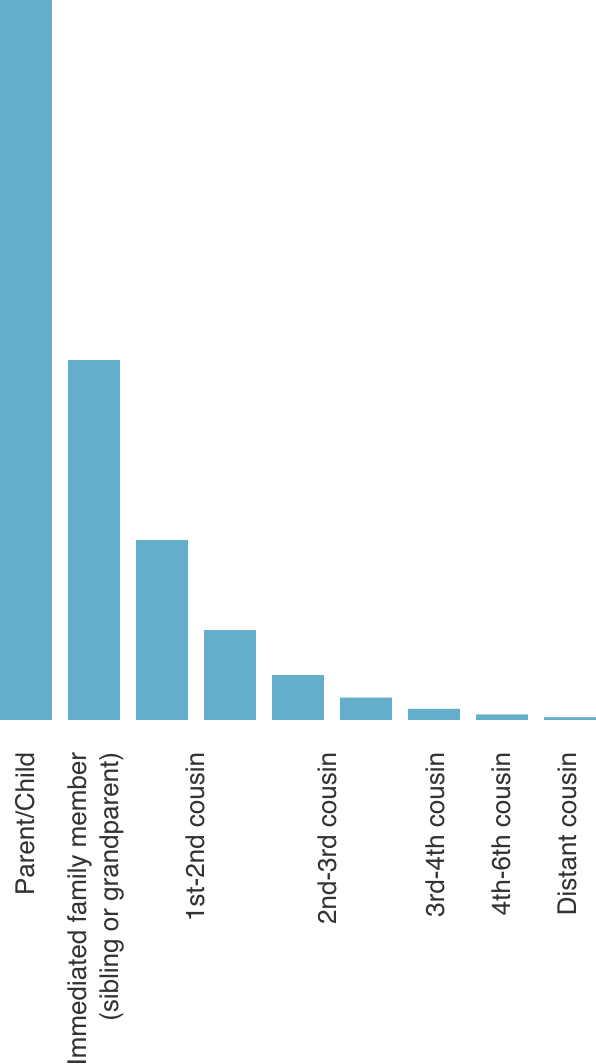
You get half of your DNA from each parent, and only half of their DNA. However, which half is passed down is random. So while you and your sibling each got half of your DNA from your mom and half from dad, only some of it is the same DNA. And while you and a cousin each inherited roughly 25 percent of your DNA from each of your shared grandparents, even less of that DNA is the same. In general, the more distantly related you are to someone, the less DNA you both share (see figure 1). You even have distant cousins that you don’t share any DNA with at all (learn how this can happen).

Find individuals with known relationships
The first step in estimating relationships is to understand just how much DNA is shared by people of different relationships. To do this, we used a dataset of individuals whose relationships had been identified—and we were confident that the relationships were correct. Using this data, for each of these relationships, we then counted the number of "inheritance events," or steps between the two people (see figure 2).
= SIBLING (M2)
= 3RD COUSIN (M8)

= SIBLING (M2)

= 3RD COUSIN (M8)

See how much DNA is shared in different relationships
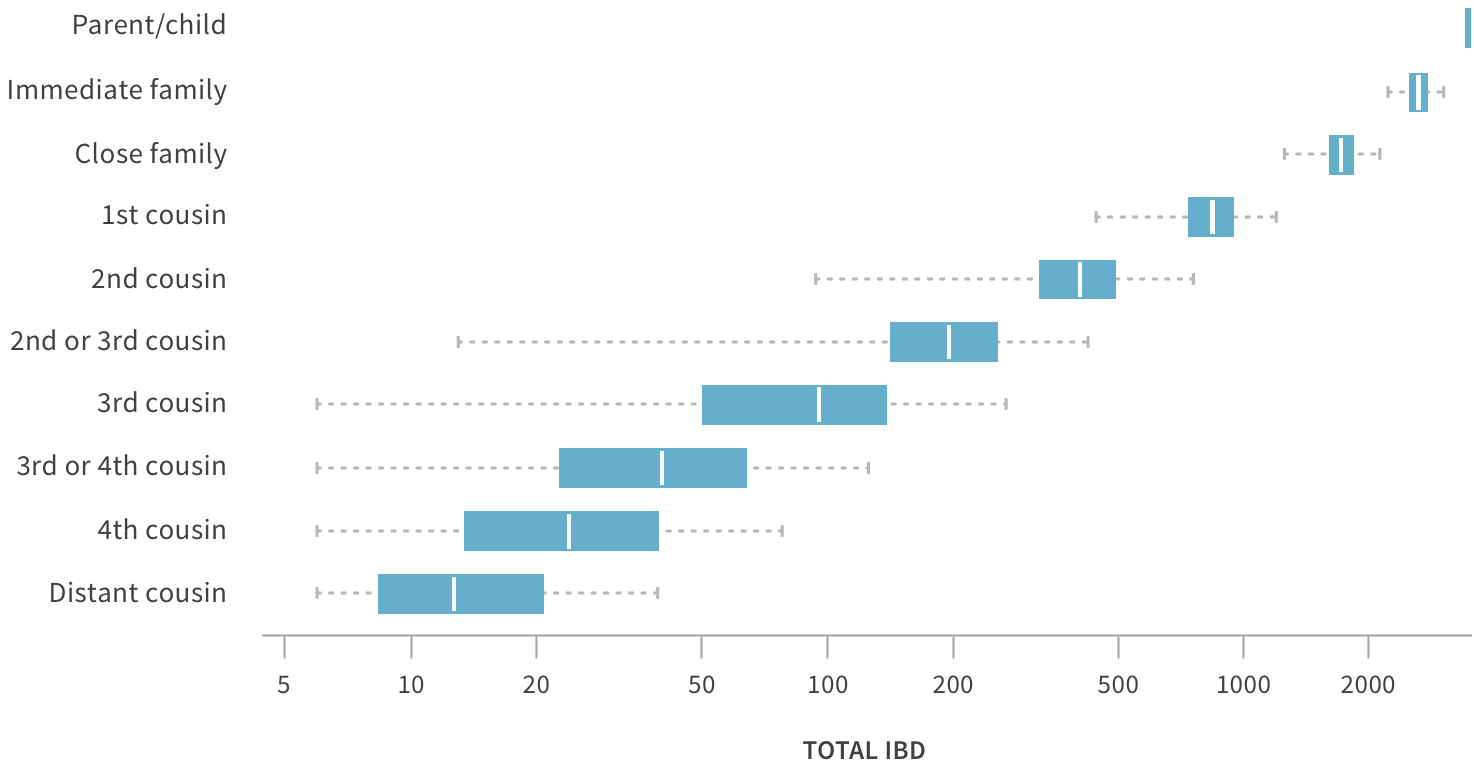
Once we have a large set of known relationships, we can start to look at the amount of DNA shared by two people with a given relationship. For example, we looked at a lot of people who were first cousins (who have four inheritance events between them), and found that there was a range in the amount of DNA that they share. We created a distribution chart that shows how much DNA is shared between individuals with different numbers of inheritance events (see figure 3).

Estimate a relationship range
The distribution chart shows the expected amount of DNA shared between people who are separated by a given number of inheritance events. So, for you and your DNA match, we look at how much DNA you share, and translate that to the most likely number of inheritance events separating you using the distribution chart. It’s fairly easy to determine a relationship type for a pair of individuals that are only one inheritance event apart (parent/child), or even two inheritance events apart (siblings), because the amount of DNA shared in these relationships is distinct from other relationships.
However, the randomness of DNA inheritance means that we can’t always determine the exact relationship between AncestryDNA members. For example, the amount of DNA shared by 3rd and 4th cousins is very similar—meaning that it is harder to tease apart these relationships with certainty. It’s even more difficult to tell the difference between a 5th cousin and an 8th cousin because the amount of DNA shared between these distant relationships is highly variable.